

Design Research · Retail Experience
Let’s look at things in a different light
The experience doesn’t end when someone puts an item in their cart. I set out to measure something retailers often forget: how the light in a dressing room changes the way shoppers see themselves, and whether they buy.
- 60
- women shoppers
- 2
- lighting conditions: overhead vs. mirror-side
- 1
- local store with good foot traffic
- 2009
- published in the Journal of Interior Design
01The Problem
Every product leader learns that the experience doesn’t end when a customer adds something to the cart. Value is decided across the whole journey: each step either builds confidence or adds friction, and friction at the moment of decision is where revenue quietly walks away, whether it’s a clunky online checkout or an unflattering dressing room.
I made the switch from commercial interior design to UX design because I was interested in consumer interactions and choices, and how visual design and user experiences translated into business gains for a company.
Retail atmospherics, a physical expression of business value, are all about making the sale, but dressing rooms are often forgotten.
I wanted to see how much they might be affecting purchase decisions. What was happening in the dressing room, and how were atmospherics affecting the customer journey?
I was a pioneer at quantifying the effects of dressing room lighting on purchase decisions. It was mostly ignored back then, but my article launched a lot more research into the dressing room effect, and I am glad that it did. It is something that shoppers care about a lot, even when many retailers don’t.
From lux to feelings
Lighting can be measured in terms of lux, lumens, candela and watts. I was the first to translate dressing room lighting dimensions and metrics into something that users could relate to: feelings.
It’s a lot like product research in that way. Both talk about conversions, users and empathy, but when it comes down to it, it is all about justifying the extra expense to business stakeholders, whether they run a digital business or a store. Dressing rooms were often an afterthought that retailers felt no need to change, until the research was there to prove that it could affect their bottom line. It was a user pain point, and like in product testing, interior design research is key to validating design solutions.
Overall environment affects a complex web of evaluations of self and experience. The same things happen when we evaluate consumer interactions with an app or product. Users continuously internalize their interactions and judge whether the experience matches their self-identity. All of this affects emotion. Users cannot always tell us what is wrong, though they often can, but we can measure their emotional affect to ensure we capture things they cannot express.
02Process and Methods
How you ask matters
One thing my dressing room research taught me, other than research methods and analysis, was that how you ask a question is important. Research is a delicate tool because, as the “observer effect” in physics teaches us, measuring or observing something changes the results.
We open the fridge and the temperature goes up. If we watch customers, they become more self-aware. And if we ask a question, we are changing how people view the problem, or even creating a problem that was not there in the first place.
If you want to read the full article or even the full thesis, you can get a more detailed breakdown. For now, here is an overview and the rationale behind the study and our choices.
Study design
- Participants. For the sake of simplicity and to minimize the number of participants required, my thesis advisor, Nam-Kyu Park, and I settled on a sample of young women.
- Setting. We found a local store with good foot traffic that offered a crisp and unadorned dressing room experience, to limit the effects of preference for one design style or another. Had time and money not been a consideration, we could have tested in multiple stores.
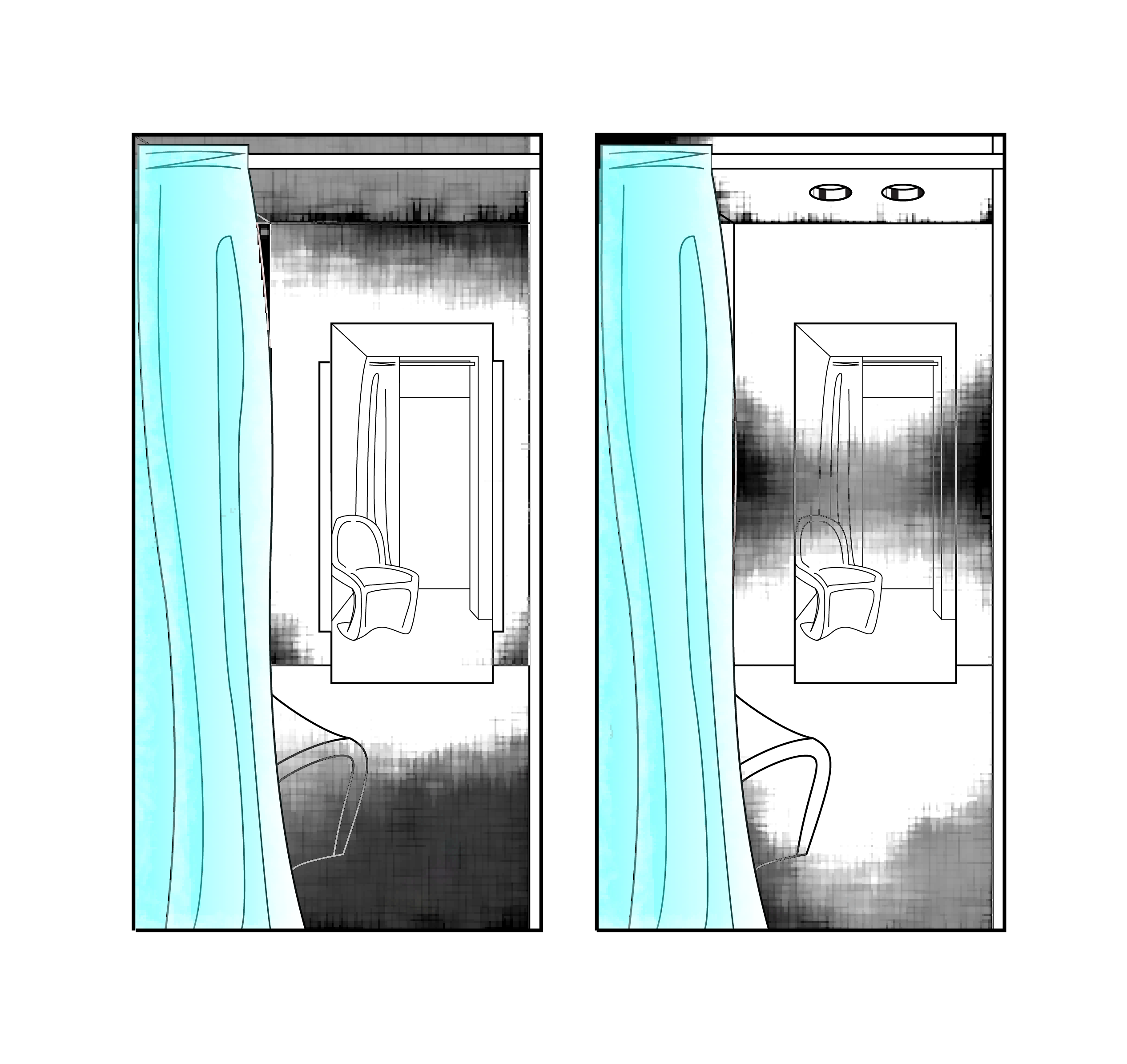
- Lighting. Lithonia Lighting donated fixtures so we could install mirror-side lighting that gave about the same level of illumination on the user as the overhead lighting, as measured with light meters.
The survey
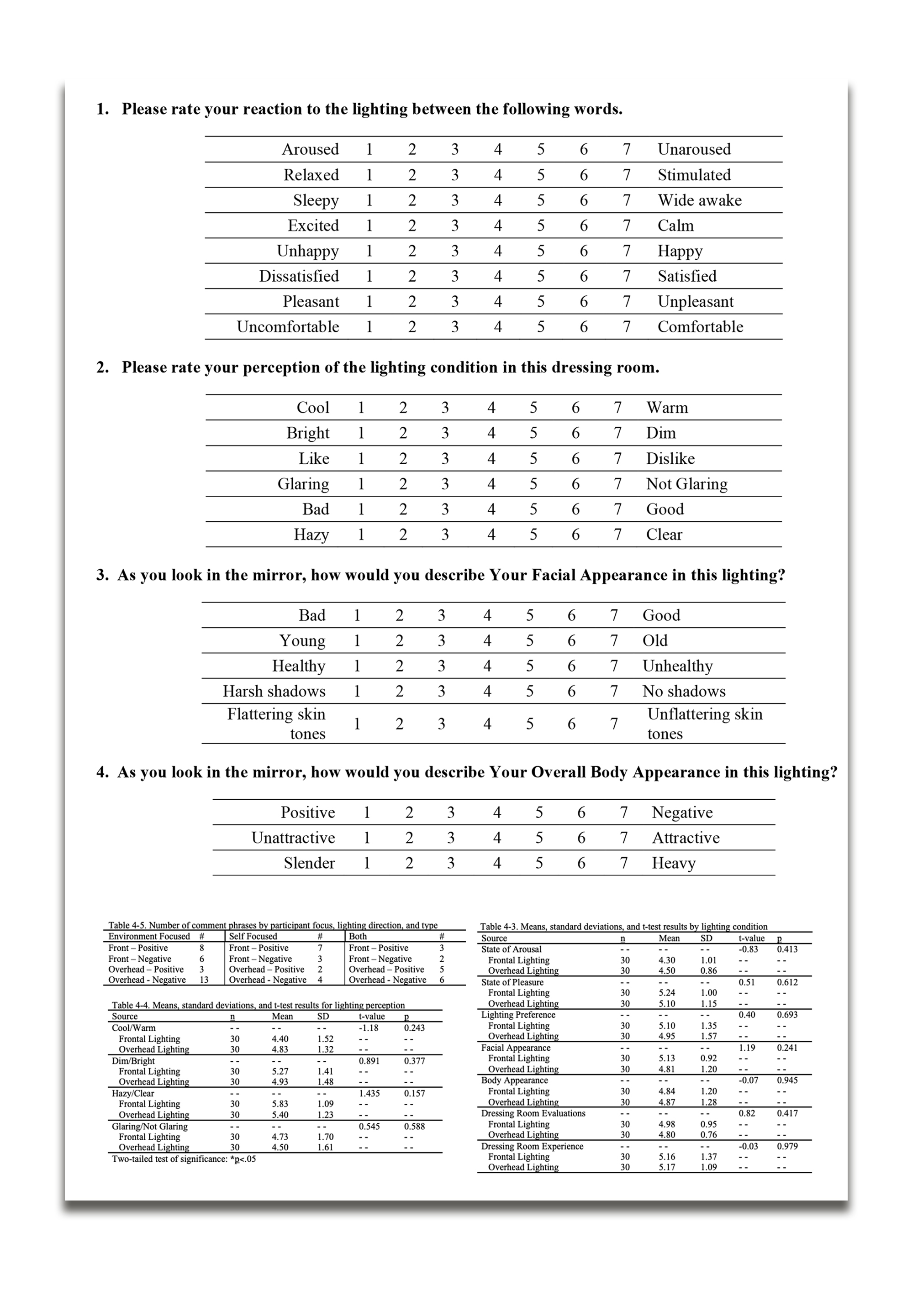
I crafted and pre-tested a long survey using semantic differentials, Likert scales and open-ended questions, with a pre-survey and an in-dressing-room survey. With my advisor, I went through a lot of survey changes.
We wanted to measure the emotional and cognitive responses, as well as the purchase intentions, without prejudicing the results with biased questions. There was no body of dressing room research to iterate on back then, so I based the questions on other environmental and marketing research. People have since used mine as a launching point.
In the field
- I was in the store administering the testing, but participants answered questions on their own in the dressing room. We could not invade their privacy, and we did not want to affect their reflections or experience.
- We wanted them to answer while standing in front of the lighting.
- All sixty women were asked to try one of the two lighting scenarios. We only got one shot, with no opportunity to ask them why or question their behavior.
- Also, very importantly, I paid them: we offered gift certificates for the store. I advertised to bring people in, but I also had to intercept a lot of customers.
03Analysis and Results
After data collection finished, I entered the results into Excel and SAS and let the computers do a bit of multivariate magic. Then I took a long look at all the data. Some things just didn’t predict purchase intention, but my advisor helped a lot to find out which combination of variables predicted purchase intent. We went through the data together.
Why intent, not purchases
We focused on intent to purchase rather than actual purchases, since a lot of times people come back after thinking about it. The only way to track whether they came back was gift certificate redemptions, and there was no guarantee those redemptions were for the same products they tried on, or that they used the same lighting condition when they came back.
What we found
- Qualitative data reinforced some of the quantitative data, and also provided some unique insights of its own.
- In a content analysis of comment types, participants in the frontal lighting condition made more positive comments than their overhead lighting counterparts: 18 positive to 11 negative comment phrases under frontal light, versus 10 positive to 23 negative under overhead light.
- The biggest finding was that purchase intention was correlated to intent to purchase, and that lighting had an effect on shadowing.
- Based on the results, I created general personas from the user types we could identify in the research, using narrative to describe how each would interact with the dressing room experience.
Consumer persona example
Self-oriented shoppers
The consumer walks in and the light is soft. Softer lighting [is] better and more flattering,
she thinks. The lighting on the side of the mirror looks calming and seems like a bar or restaurant in the evening.
It is trendy, and it fills the room with even light. I look pretty good for having been out most of the night, she thinks. She leans into the mirror and starts to trace her fingers over her face. Maybe a little tired.
She sets her bag down on the chair and hangs her clothes on the hook. She takes off her shirt and pants and does not mind seeing herself in the mirror. I love the lighting. It [makes] me look like my skin ha[s] a healthy glow. Also, my eyes look amazing. The light is very flattering.
She puts on what she picked out and twirls in front of the mirror briefly before fixing herself in one place and evaluating her appearance more closely. She is glad she has been going to the gym because she looks skinny. Or is it the lighting? I feel like it is flattering,
she thinks, slimming, and exciting.
Still looking in the mirror, she evaluates the hem of the dress. It hits her at just the right place on the leg. Not too long and not too short. It makes her legs look slender. The color is good too, she thinks. She decides to buy it.
She tries on another dress. It is a little longer, and black. She immediately hates the way it looks. It is too long, and against the black curtain it is hard to see how well the dress fits me.
The other dress was more vibrant and, now that she thinks about it, made her more tan. She buys the first dress.
04What This Means for Product
The dressing room experience was much more dynamic than just the customer’s interaction with clothes. When we asked participants what was important to them, they had a very clear list:
- Chairs
- Hooks
- Carpeting
- And, of course, lighting
Retailers have always wanted to know how their shoppers were interacting on the sales floor, and how they could use the store to get people to try the clothes, shoes or sporting equipment. Yet if you stop there, you are missing a very key part of the experience. No one part of the experience is less important than another.
The same is true for digital products, and it is where research earns its place in driving value:
- Marketing, graphics and great reviews can get people to download an app or try a product.
- But once they are using the product, all the marketing and buzz won’t save a poor experience.
- That affects referrals and continued engagement. That affects revenue.
- Customers don’t need every feature in the world. They need quality ones, and research is how you know which.
- Research turns what people feel into evidence that justifies the investment, the same way it moved retailers to change their dressing rooms.
Well-researched, well-built products are what keep customers coming back.